
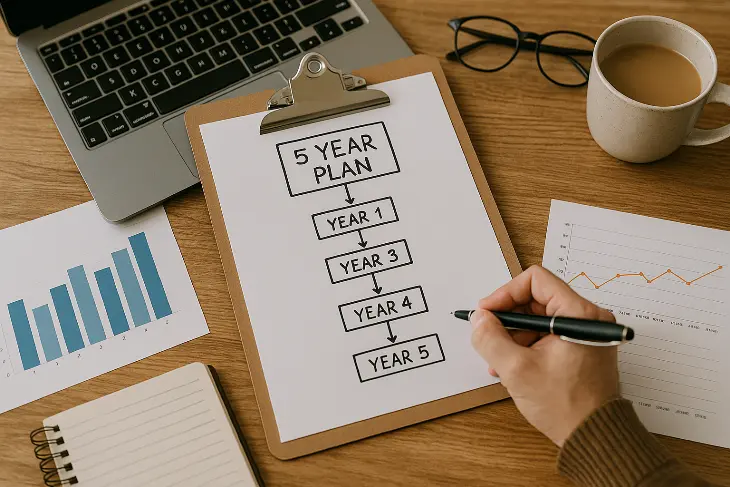
Let’s be honest: in today’s fast-paced world, thinking 5 years ahead might feel like planning a moon landing.
But if you’re serious about building something that lasts – not just a quick win or viral hit – you need a long-term game plan. That’s where the 5-year business strategy comes in.
Whether you’re running a startup, solo business, or scaling a growing company, this article will help you build a clear, actionable 5-year plan that bridges today’s hustle with tomorrow’s goals.
Let’s turn your vision into a strategy – and your strategy into sustainable growth.
Why a 5-Year Plan Matters
A 5-year business plan helps you:
- Set a clear direction for growth
- Align your team around shared goals
- Make better decisions today with the future in mind
- Avoid burnout by pacing your growth
- Attract investors, partners, or talent with a compelling roadmap
Think of it as a business GPS – you still have flexibility, but you always know where you’re heading.
Step 1: Define Your Long-Term Vision
Start by asking:
“What does success look like in 5 years?”
Be specific. Think beyond revenue. Include lifestyle goals, team structure, impact, and market position.
Questions to ask:
- How big do I want the business to be (revenue, reach, team)?
- What kind of work do I want to be doing – or not doing?
- Who are my customers, and how am I serving them?
- What legacy or impact do I want this business to have?
Pro tip: Write your 5-year vision in present tense like it’s already happened. It helps anchor your mindset.
Step 2: Set Milestones for Each Year
Break your 5-year vision into annual milestones that represent key checkpoints.
Example Structure:
Year 1 – Launch, validate, generate first $100k
Year 2 – Build audience, systemize operations, break $250k
Year 3 – Hire team, expand products/services, reach $500k
Year 4 – Optimize processes, explore partnerships
Year 5 – Scale confidently, hit $1M+, build brand equity
Each year should build on the previous one, with clear priorities and outcomes.
Step 3: Align Short-Term Goals with Long-Term Strategy
Your quarterly and monthly goals should ladder up to your yearly milestones.
Use this structure:
- Vision → 5-Year Plan
- Milestones → Annual Goals
- Projects → Quarterly Initiatives
- Tasks → Weekly and Daily Execution
Example:
- 5-Year Vision: Build a SaaS that generates $1M ARR
- Year 2 Milestone: Reach 10,000 users
- Q2 Goal: Launch paid beta
- Weekly Task: Interview 10 target users
Tool tip: Use a dashboard in Notion, ClickUp, or Trello to keep everything aligned and visible.
Step 4: Track Progress & Adapt Regularly
A plan is only useful if it’s flexible.
What to review monthly or quarterly:
- Are we on track with this year’s milestone?
- What’s working? What’s not?
- Are there any external shifts (market, competitors, tech) to respond to?
- Do we need to adjust the timeline, budget, or focus?
Use real data, not just gut feeling. Tools like Google Analytics, Stripe, QuickBooks, and customer feedback help you measure impact.
Bonus: Create a “Year-in-Review” doc every December to reflect and reset.
Step 5: Build for Sustainability, Not Just Speed
Growth is great – but not if it burns you out or breaks your systems.
To scale smart:
- Automate before you delegate
- Systemize tasks that repeat
- Hire slowly and intentionally
- Maintain cash reserves
- Stay consistent with brand, voice, and values
Remember: scaling too fast can be as risky as not growing at all.
Cultural tip: Revisit your company’s mission and values annually to keep your growth aligned with what matters most.
Use the 5-Year Plan to Attract Support
A solid long-term plan isn’t just an internal tool. It can also help you:
- Pitch to investors
- Recruit high-level talent
- Form strategic partnerships
- Set shared goals with co-founders or advisors
Clarity attracts confidence. And confidence brings capital, collaboration, and growth.
Your 5-year plan doesn’t need to be perfect – it just needs to be intentional.
When you have a long-term vision, everything changes. You make better choices. You stop chasing shiny objects. And you build something that lasts – not just for today, but for the future.
So carve out time, grab a whiteboard or a coffee, and map it out. Your future self will thank you.